Tell us about the job
Takes about a minute. No obligation.
A contractor quoting boiler repair in Lac qui Parle County has to work out what actually drove the failure before pricing parts, and the area's weather record does not usually point the finger. 96 severe weather events were recorded in Lac qui Parle County, Minnesota between 2015 and 2024. That puts this county near the middle of the national range, meaning severe weather is a real but occasional presence, not a grinding constant. Most boilers that fail here have given out because a heat exchanger cracked with age, a pressure relief valve was never tested, or a circulator pump ran dry. The weather is background; the service history is what a contractor examines first.
Prewar construction puts a specific pressure on boiler repair work. Half the homes in Lac qui Parle County, Minnesota were built in 1951 or earlier (2020-2024 ACS 5-year). A system installed in a house built that long ago has often been replaced or patched more than once, and what a contractor finds inside the opened unit reflects that layered history: valves, controls, or heat exchanger sections from manufacturers who no longer supply those components. The repair scope depends on whether a matching part still exists, and in housing this old that is a real question before any quote makes sense.
The Parts of a Boiler a Contractor Checks First
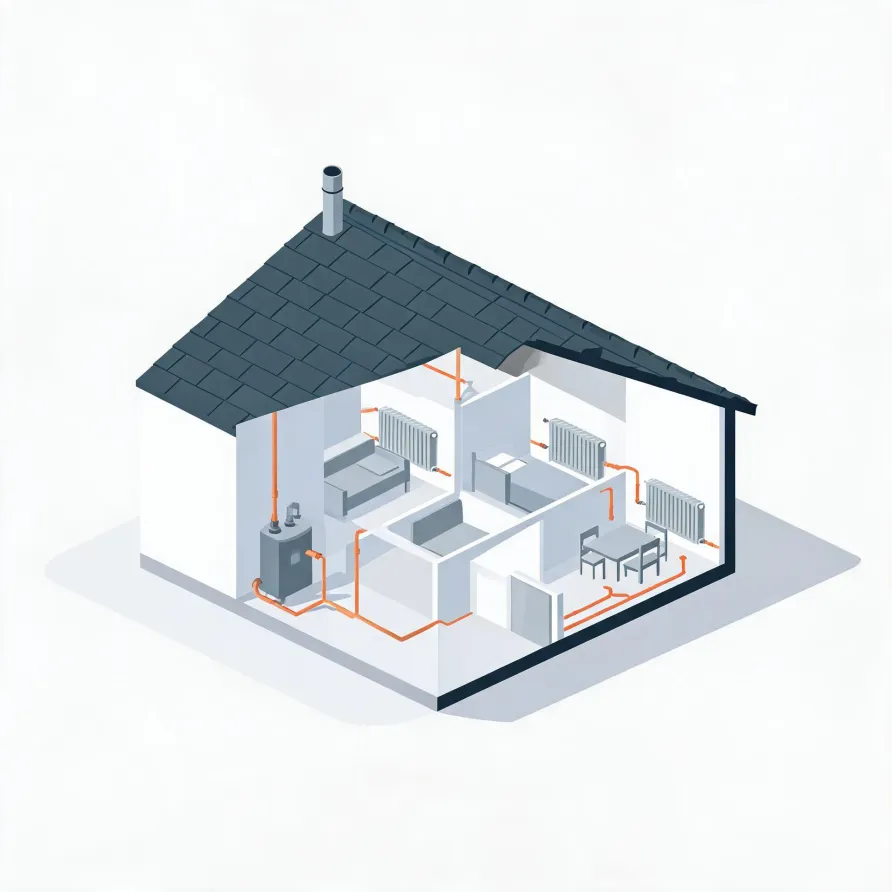
The boiler itself sits in the basement or mechanical room and is the heart of the system: it heats water that gets pushed through the house. A contractor will look at the heat exchanger inside the unit early, since a crack or scale buildup there affects everything downstream. The burner assembly, which sits at the base of the boiler, is another early stop.
Radiators and baseboard convectors sit in each room and release heat into the living space. The circulator pump, mounted on the supply or return piping near the boiler, keeps water moving through the loop, and a failed pump is a common reason a boiler runs but rooms stay cold. The expansion tank and pressure relief valve sit close to the boiler and protect the system if pressure climbs too high.
The drawing shows a typical boiler layout, and a licensed contractor will determine which components apply to the specific system in your home.
Get matched in Lac qui Parle CountyLac qui Parle County, by the record
96 severe weather events were recorded in Lac qui Parle County, Minnesota between 2015 and 2024.
NOAA National Centers for Environmental Information, Storm Events Database, bulk CSV export, events 2015-01-01 through 2024-12-31.Half the homes in Lac qui Parle County, Minnesota were built in 1951 or earlier (2020-2024 ACS 5-year).
U.S. Census Bureau, 2020-2024 American Community Survey 5-Year EstimatesLac qui Parle County, Minnesota holds 3,469 housing units (2020-2024 ACS 5-year).
U.S. Census Bureau, 2020-2024 American Community Survey 5-Year EstimatesOwners occupy 82.5% of the occupied homes in Lac qui Parle County, Minnesota (2020-2024 ACS 5-year).
U.S. Census Bureau, 2020-2024 American Community Survey 5-Year EstimatesCodes & Standards Governing Boiler and HVAC Repair in Lac qui Parle County, Minnesota2 sourced rules and standards
Licensing and Legal Requirements in Lac qui Parle County, Minnesota
Minnesota defines a mechanical contractor as a business that installs, repairs or maintains heating, ventilating, cooling or refrigeration systems — the definition that carries the exemption from the residential contractor licence.
Minnesota's residential contractor licence does not reach HVAC work: the licensing section carries its own exemption list, and a mechanical contractor is exempt from the licence requirement by name.
Severe Weather Events in Lac qui Parle County
Extreme weather puts stress on boiler systems: hard freezes, sudden temperature swings, and power disruptions all take a toll on components that are already working at capacity. How much of that load a boiler carries depends on where it is, and Lac qui Parle County has its own weather history.
96 severe weather events, 2015–2024. Source: NOAA National Centers for Environmental Information, Storm Events Database.