Tell us about the job
Takes about a minute. No obligation.

A boiler repair contractor working in Itasca County starts from what the system has already been through before drawing any conclusions about a failed part. 295 severe weather events were recorded in Itasca County, Minnesota between 2015 and 2024. At that rate, severe weather is part of the normal operating life of every boiler in the county, not an occasional interruption. Heat exchangers, pressure relief valves, and expansion tanks carry that load season after season, and a contractor checks each of them for cumulative wear before attributing a failure to one component alone.
Boilers in houses built this long ago carry a repair history inside them that a contractor reads only after opening the system. Half the homes in Itasca County, Minnesota were built in 1979 or earlier (2020-2024 ACS 5-year). That means a technician called out for what appears to be a single failing component will check heat exchangers for corrosion, expansion tanks for waterlogged bladders, and circulator pumps for worn seals before settling on a scope. Parts in a system this old can be difficult to source, and that availability question shapes the repair path as much as the diagnosis does.
The Parts of a Boiler a Contractor Checks First
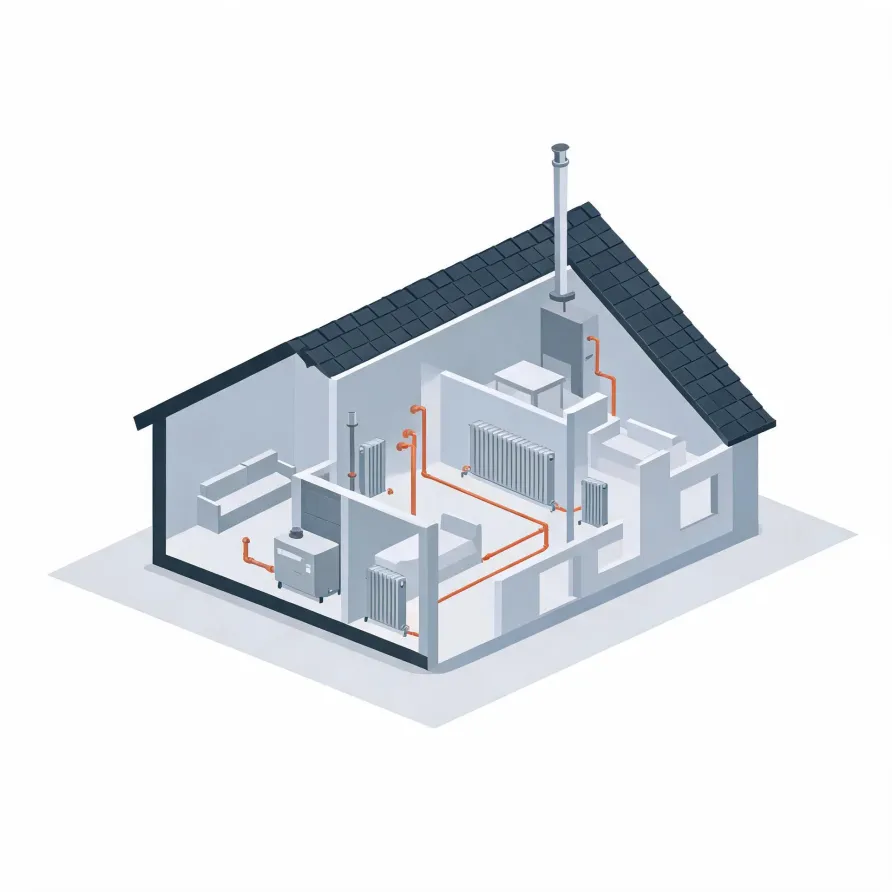
The boiler itself sits in the basement or mechanical room and is the piece a contractor goes to first. It heats water and pushes it through the system. When a boiler is short-cycling, losing pressure, or failing to fire, the problem usually starts here, in the heat exchanger, the burner assembly, or the pressure relief valve.
Copper or steel pipes carry the heated water to radiators or radiant panels in each room, and a circulator pump keeps it moving. The expansion tank, mounted near the boiler, absorbs pressure changes as water heats and cools. A faulty pump or a waterlogged expansion tank are common sources of uneven heat or pressure faults.
The drawing shows a typical boiler layout, and a licensed contractor will determine which components apply to your specific system.
Get matched in Itasca CountyItasca County, by the numbers
295 severe weather events were recorded in Itasca County, Minnesota between 2015 and 2024.
NOAA National Centers for Environmental Information, Storm Events Database, bulk CSV export, events 2015-01-01 through 2024-12-31.Half the homes in Itasca County, Minnesota were built in 1979 or earlier (2020-2024 ACS 5-year).
U.S. Census Bureau, 2020-2024 American Community Survey 5-Year EstimatesItasca County, Minnesota holds 25,679 housing units (2020-2024 ACS 5-year).
U.S. Census Bureau, 2020-2024 American Community Survey 5-Year EstimatesOwners occupy 83.0% of the occupied homes in Itasca County, Minnesota (2020-2024 ACS 5-year).
U.S. Census Bureau, 2020-2024 American Community Survey 5-Year EstimatesBoiler Repair Rules & Standards on File for Itasca County, Minnesota2 sourced regulations and codes
Licensing and Legal Requirements in Itasca County, Minnesota
Minnesota defines a mechanical contractor as a business that installs, repairs or maintains heating, ventilating, cooling or refrigeration systems — the definition that carries the exemption from the residential contractor licence.
Minnesota's residential contractor licence does not reach HVAC work: the licensing section carries its own exemption list, and a mechanical contractor is exempt from the licence requirement by name.
Severe Weather Events in Itasca County
Extreme weather puts real strain on boiler systems, and Itasca County's climate shapes how hard that equipment has to work over time. Repair needs here follow local conditions, which is why the record below matters.
295 severe weather events, 2015–2024. Source: NOAA National Centers for Environmental Information, Storm Events Database.